
June 12, 2026
Five Dollar Friday, the Keedoozle, and a stolen pack of Juicy Fruit

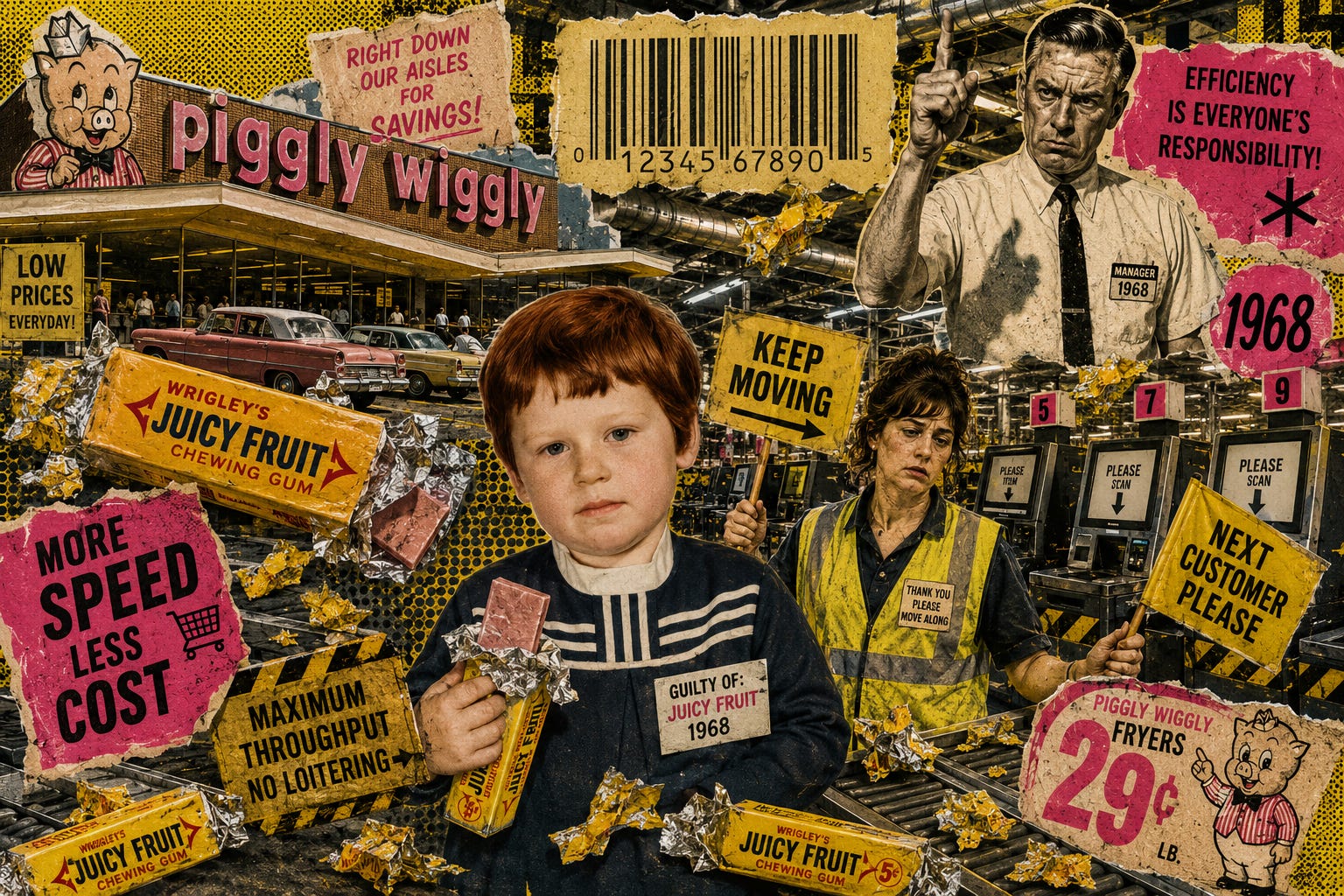
It’s Friday morning, and I’m sitting on my front porch eating sushi for breakfast. This is Five Dollar Friday sushi, picked up early enough to beat the lunch rush, which is the only way to do it. My grizzled old rescue dog, Lucas, is sitting next to me watching the golfers across the street with mild interest.
The lunch rush happens in a store that sits between two over-fifty-five communities, each one built around a golf course. “Active senior citizens”, the brochures call the residents. This grocery store is part of a chain that runs a promotion called Five Dollar Fridays, and I freely admit I’m in on it almost every week. Thursday night I open the store app and read the weekly flyer to see what the five dollar specials will be. And then when I get to the store, a few of them are surprising. I always head to the sushi counter, because that’s never in the flyer.
Skipping the lunch rush is key, because there is always a line. If you say the name and location of this store to anyone inside twenty miles, they laugh, roll their eyes, and tell you their own story about the legendary hell this grocery store can be. It’s famous, but not for the sushi.
Here’s why. Between, say, ten in the morning and six at night, you are not going to get out of that store in less than twenty minutes. There is one real checkout line with one human being ringing groceries, and that human is usually a little older than the golfers. There’s that one checkout line, and then there is the dreaded self-checkout kiosk cluster.
And by cluster, I mean cluster-you-know-what. Because that’s what the kiosks are. Picture a crowd of over-fifty-five people checking out their own groceries, operating a machine where anything without a barcode is a negotiation. Healthy food. Fruits, vegetables, anything you have to weigh, anything that has to be looked up by hand. It’s a nightmare.
On Five Dollar Friday it’s extra-special, because now there are coupons and these low low prices in play, and you cannot always tell if the right thing rang up. The flyer says it’s going to be five dollars. The screen says eleven dollars and forty-seven cents. You stand there deciding whether it’s worth flagging that guy down, and the people around you are all doing the same math.
I struggle with those self-checkout kiosks. I almost always pick the human checker. But it isn’t only because I can’t work a machine. I was actually trained to run a checkout before any of this whizbang fancy scanner stuff even existed.
I learned to check out groceries in high school and through college, before barcodes. This was during the day when there were price stickers on everything, and you had to key the prices in by hand on a register pad, five fingers with your middle one on the bump. No looking down while you swiftly pushed the items down the belt. Not only did you have to get the price, you also had to key in the code if it was a health and beauty item, because in the state of New Jersey those didn’t get taxed. So when I tell you I struggle at the kiosk, I’m not a stranger to checking out groceries. I’ve been on the other side of the counter, and I was always faster than the machine when I was twenty years old. But now the machine beats me every time.
Clarence Saunders opened the first Piggly Wiggly in Memphis in 1916. Before him, you walked into a grocery, handed a clerk your list, and he gathered it for you. He climbed the ladder, he weighed the flour, he pulled the cans. Saunders fired that arrangement. He put up turnstiles, lined the goods on open shelves, handed the customer a basket, and sent her to do the gathering herself. He patented it. He called it self-service, and he sold it as freedom. What it was, underneath, was the day the store stopped doing the work and the customer started. We have been doing the store’s walking ever since. We just call it shopping now.
Saunders wasn’t finished. In 1937 he built a thing called the Keedoozle, which stood for “key does all.” It was a grocery you ran by machine. You carried a key, you put it in a slot beside a glass case, you punched your order onto a ticker tape, and a conveyor belt was supposed to deliver your goods to the front. The first fully automated store in America. He opened it three times. It failed three times. The circuits jammed at peak hours and people got the wrong groceries and the repair bills buried it for good by 1949. When it died, Saunders did not blame the wiring. He said the concept was too much for the average brain to comprehend. He blamed the shoppers. The man who invented self-checkout decided the customer was the broken part.
Then the barcode. June 26, 1974, 8:01 in the morning, a Marsh supermarket in Troy, Ohio. The drawing had been around since 1949, when an inventor named Joe Woodland worked it out in the sand on Miami Beach, lines pulled out of Morse code, laid in circles. IBM’s George Laurer squared it into the rectangle we know. The man from Marsh research and development, Clyde Dawson, reached into a cart and pulled out a ten-pack of Wrigley’s Juicy Fruit. The cashier, Sharon Buchanan, ran it over the glass and the register read it. They picked gum to prove the code would print on something small. It was built so management could track inventory and know what was selling and what was sitting. Universal Product Code. UPC. The whole point was universality. One language every shelf could speak.
A cashier scanned the first one. The tool that would eventually move the scanning to the customer was christened by the woman it was built to replace.
So when I was doing the research for this article, what Saunders said stuck in my average brain. The concept was too much for a human. In 1949 he said it about his own broken Keedoozle, which would be an epic name for these self-checkout situations. The Five Dollar Friday store says it too, every time the screen tells you to wait for the attendant. The machine is never the broken part. You are.
So checkers like Sharon got replaced by the machines. But also a group of six or seven checkers got replaced by one guy in a safety-yellow vest. High visibility, because apparently checking out groceries is now akin to being on a work site. The guy at the Five Dollar Friday store carries a couple of flags. He herds people into the kiosks, and then he runs up and down the rows trying to help six of them at once figure out how to ring up their own effing groceries. There’s one human where there used to be a line of registers, and this human is putting out small fires with his hands. He doesn’t look like he enjoys it. I wouldn’t either. They took a job that meant talking to one person at a time, and they turned it into traffic control.
When I was doing the research, a memory came up for me and that memory goes back to being five years old in Elgin, Illinois. I got fifteen cents a week for allowance, and I loved to spend it at the Ben Franklin on penny candy. Our grocery store was the Piggly Wiggly, and it was about a block away from our home. My mom would round up her four children and walk us there, pushing the baby in the stroller, and we’d shop for the night’s dinner so supper would be ready when my father got home. Here’s the thing about me. I loved candy. And if I had already run through my allowance for the week, my mother was not going to cave and buy me a pack of gum.
I don’t remember the hot thrill of thieving. I remember getting caught, hiding in the closet in my bedroom with my mouth crammed full of five pieces of Juicy Fruit, bright yellow wrappers and tinfoil all over the floor around my feet. That earned me a spanking. Then I had to gather up all the evidence before being frog-marched down to the Piggly Wiggly with my mad-as-hell mother and the littles, to confess to my crime.
We had to knock on his office door. He was a tall man in a white shirt with a black tie. Managers were very formal back then. I hung my head and mumbled that I’d stolen a pack of gum, and I held out the evidence while I tried to get my allowance purse open at the same time, digging for the nickel my mom had loaned me to pay restitution. He was stern. I kind of remember his finger wagging back and forth in my face. I was very ashamed and holding back tears. Much worse than a spanking.
And then he crouched down and looked me in the face. He told me I was brave. He said he was proud of me for coming clean. He also told me that he didn’t want me to grow up to be a criminal and live a terrible crime life. I had seen Perry Mason and I took it quite seriously, picturing hard time behind bars.
Years later, when I actually worked in a grocery store, when I checked people out, I got to know them by talking to them. There were regulars from the neighborhood. I knew which days folks came in and what they liked to buy. Stand behind the cash register long enough and the same people come back. And sooner or later you’re part of a small recurring scene with a cast of characters you know. Sometimes you get surprised by somebody new. People in line talk to each other too. They comment on if the cherries are sweet yet or if they think the weather is going to change.
That’s what I’m standing in line for on Five Dollar Friday. The one checker, older than the golfers, and a Friday hello. It’s a ritual and it takes two people. The kiosk can’t give you that. People are too stressed to talk. They are in machine mode. I’ve gone through the kiosk plenty, and when it jams I flag down the man in the vest, and that’s human too, in its way. It just isn’t relaxed and it isn’t fun. It’s a worksite. He’s putting out fires. I’m one of the fires.
They built a universal language for the groceries. Universal Product Code, one barcode every shelf in the world can read. But there is an older universal, and it is about the people who are part of that grocery store community. Aristotle said poetry was more philosophical than history, more serious, because history just tells you what one person did on one day, and poetry reaches the universal. The kind of thing any person would do, a pattern you recognize because it could be you, a conversation you’ve had a thousand times. The universal was never the object. It was the human action. The confession in that office is universal in an old way. I think there was a Dennis the Menace episode just like my real-life story. A child, a stolen pack of gum, a tall man in a tie who decides to kneel and forgive. Everybody knows that scene.
The UPC made a can of beans universal and started the other universal, the part that happens between people in conversation, fading away. I go to the checkout line on Five Dollar Friday because I want to know if that new dirty soda is any good and if their grandkid enjoyed their graduation party.
JB I so with you! How are we letting this happen? We have been slowly conditioned to accept self checkout for years, and it seems to be only getting worse.
When I use a self checkout and something goes wrong, I'll jokingly apologize to the clerk and say, "Sorry, I didn't receive proper employee training."
And when "Karen-Annoyed" shows up, I start asking the important questions: "When do I get my W-2?" or "I'd like to speak to the manager about a raise." Because at this point I'm scanning, bagging, weighing produce, checking prices, troubleshooting technology, and performing quality control on composting produce. Somewhere along the way, the customer became part of the workforce. The only thing missing is an employee discount. Perhaps I need to speak about that with the manager for next time!
Thank you! So interesting! I never knew this history! And your personal story is actually fun way to remember how close people were used to be back then. Mon taking you to those managers and talking.